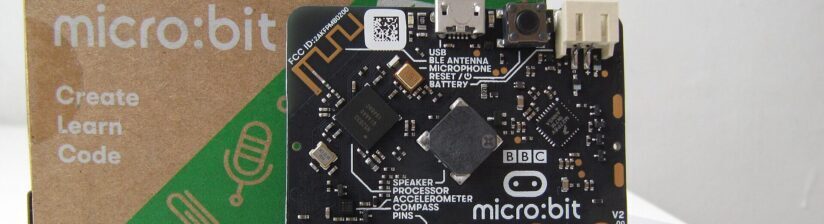
Amateur radio direction finding is hide-and-seek played over the air: one device transmits from a hiding place; everyone else carries a receiver that reports how strong the signal is, but not which way. Radio amateurs call it a fox hunt. I have built a version for two BBC micro:bits – the hidden board is the Treasure and the receiver is the Hound. I’ve released it, free to use, in time for National Coding Week, 14 to 20 September.
You’ll need two or more micro:bit V2 boards with battery packs, a computer preferably with Chrome or Edge, a USB data cable, and a space about 20 m across. Copying the game onto a board takes about half a minute for the first and seconds for each after, with nothing to install and no account. You need one Treasure and one Hound per group; the Hounds only listen, so any number can hunt the same Treasure at once. The boards may already be in your cupboard: Nominet funded 675,000 micro:bits for UK primary schools, delivered with the BBC and the Micro:bit Educational Foundation in 2023-24.
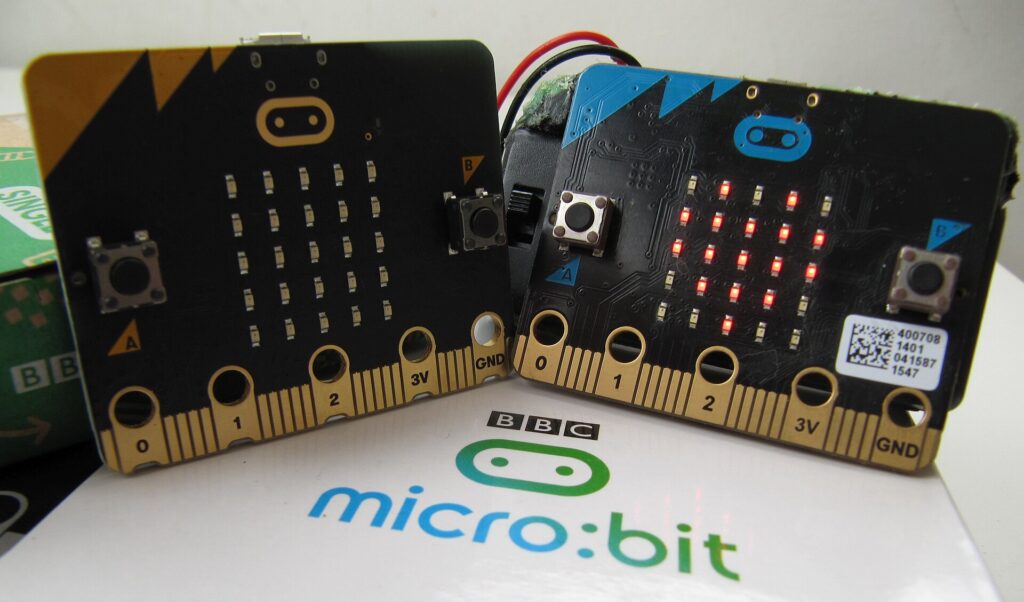
We also provide a 90-minute lesson plan for Upper Key Stage 2 (or two 45-minute sessions), a pupil worksheet that runs it as a measurement investigation, and a one-side-of-A4 hunt card for a 20-minute game where the goal is just to find it.
The objectives are the same whether you run the lesson or the twenty-minute version: that a radio signal weakens with distance, shown from their own measurements; that solid objects, a body included, block and reflect it, which is how you find a direction when the receiver gives none; and that an instrument reading its maximum has stopped telling you anything, which is why the Hound has an attenuator. The lesson plan sets each against the England programmes of study: upper Key Stage 2 working scientifically (repeat readings, controlling variables, line graphs) with Year 6 light, Year 4 sound, and Key Stage 2 computing for networks and presenting data.
This activity builds on those released by the RSGB in this and previous National Coding Weeks: Python Pocket Morse and a high-altitude balloon last year; Morse on the micro:bit, an energy-use activity and pulse width modulation on a Pico this year. Those teach how to write code. Ours is a natural follow-on that inverts the exercise: the program is already written, and the challenge is to understand how radio waves behave.
Please tell me how it goes. You can post an issue on GitHub or email me. The RSGB is collecting accounts of National Coding Week activities until 30 September.